A BRIEF INTRODUCTION ABOUT MY SELF:

My name is Ana Martinez Rubio. I was born on January 5, 2000 in Zaragoza. I currently live in Zaragoza. My parents are Jesús Martínez Gallardo and Rosario María Rubio Jordán. I have a little brother named Jesús Martínez Rubio who is 17 years old. I am a second-year student of the Infant Education Degree at San Jorge University (USJ). I have taken the DECA and I am preparing for the theoretical driving test.

Since I was a little girl I have always been moved and I have asked myself why. I went to the Montessori nursery until I was 3 years old. I studied at the Hermanos Marx Public School from 1st Nursery to 6th Primary, of which I have very good memories. Later on, I studied at the IES Tiempos Modernos from 1st of ESO to 2nd of Bachillerato, the year in which I graduated in Bachillerato in Social Sciences.

My most defining characteristics are that I am an open person, active, happy, with character, I usually have confidence in myself in everything I do, creative, demanding, flexible, skilful, I have the capacity to lead, sometimes lazy and lazy, motivating, optimistic, organized, impatient and sincere.

My personal goals are to try to be a better person, a good daughter for my parents, as well as a good student so that they can be proud of me. And my academic goals are to perform to get good grades at the end of this course, and the remaining 2 years of my career and so in 4 years to finish the career and get a job as a teacher of child to be able to be in a school concerted / private Zaragoza. I will also get a C1 in English and a B2 in French.

The people who have influenced me to be the way I am today are obviously my family, above all because of the values they have instilled in me since I was a child, and also my friends since I spend a lot of time with them too.

What I want to do in life is, without a doubt, to be happy with what I do in the end. What I would like is to be a kindergarten teacher, as I said before, and to have a family. I would also like to continue being involved in basketball in some way, since I love it.

What I think I can contribute to education is to teach my future students to live together, to be good people, to teach them, to learn with them, to educate them.

With my daily effort, educating while enjoying, and all this under the values of inclusion.

TASK 1

A brief introduction to this task: this task consists in making a small reflection on the practicum that we had the opportunity to live this year in February attending a school.

• What did you learn about teaching and working in a school from this experience?

What I have learned about teaching and working in a school from this experience has been many things since I think that in practice you learn a lot more than in the theory that we give in class since as much as we learn a lot of theory in the career if we don’t put it into practice in the schools it serves very little.

This experience that we had the opportunity to live, to be really in a school within a classroom, in my case a nursery school, was incredible because I lived what it was really like to teach children in nursery school, that you have to have a lot of energy throughout the day because with children so young you have to be active every day, how important it is to listen to all children and not only to those who cost more because if other children who are doing well may feel that you are not good for them, how important it is to have the desire to make materials for them to learn in the most fun and appropriate, how good it is that the class is distributed in corners to facilitate their learning and know where everything is etc.

• What did you learn about yourself through this experience?

What I have learned about myself through this experience has been that I really felt that I want to dedicate myself to teaching. Besides that I learned about myself that with the children of infancy you do not have any shame since they do not judge simply for them everything is a game in which they are learning many things, also I was able to give class and that the children were paying attention to me as if I was their teacher of all their life and that surprised me since I thought that I was not going to be able to capture their attention completely.

• What was your biggest success in this practicum?

My greatest success in this practice was being able to give a whole psychomotor class, which is the mention that I will almost certainly take in 4th grade, since I really like everything related to sports, to give the psychomotor class I prepared each and every one of the exercises that the children did. The children paid attention to me and the most important thing was that they liked me very much since most of them told me and the teacher did too and so that they told me that for me was a great joy and a success.

• What have you done that you didn’t ever think you would be able to do?

What I did that I never thought I would be able to do was to teach, both the psychomotor class, a little bit of an English class and the assemblies they did in the mornings. Because I thought that in the second-year practice, they were not going to let us teach, I thought that I was only going to be in the classroom helping the teacher and dedicating the most time to the analysis of documents. But finally, thanks to the teacher who touched me it was the opposite and I am very grateful.

• What changes would you make if you had the chance to do this over again?

I sincerely believe that I wouldn’t change anything if I had the opportunity to do this again because for me this experience was great, I can’t find anything that would change, I would repeat it in the same way one and a thousand times more.

• How would you describe your teaching style based on your behaviour during the practicum?

I would describe my behavioural teaching style during practice as one in which being active during all class hours is predominant, that children are comfortable and relaxed and that with the resources they use they learn whether they are ICT or not.

• What did you learn from any challenges you faced during this experience?

What I learned from the challenges I faced during this experience was that you have to have a lot of patience with the children because maybe some of them would rather be in the chair than in the assembly and that while they are listening there is no need to force them to sit in the assembly, that you have to know how to deal with the anger between them, how difficult it can be sometimes to teach because the children that day are very excited but you don’t have to lose your temper etc. 

• How would you like the pupils you taught to remember you?

I would like the students I teach to remember me as their teacher in practice, to remember me as I was with them and that if they ever saw me, they would remember me, I would be very happy.

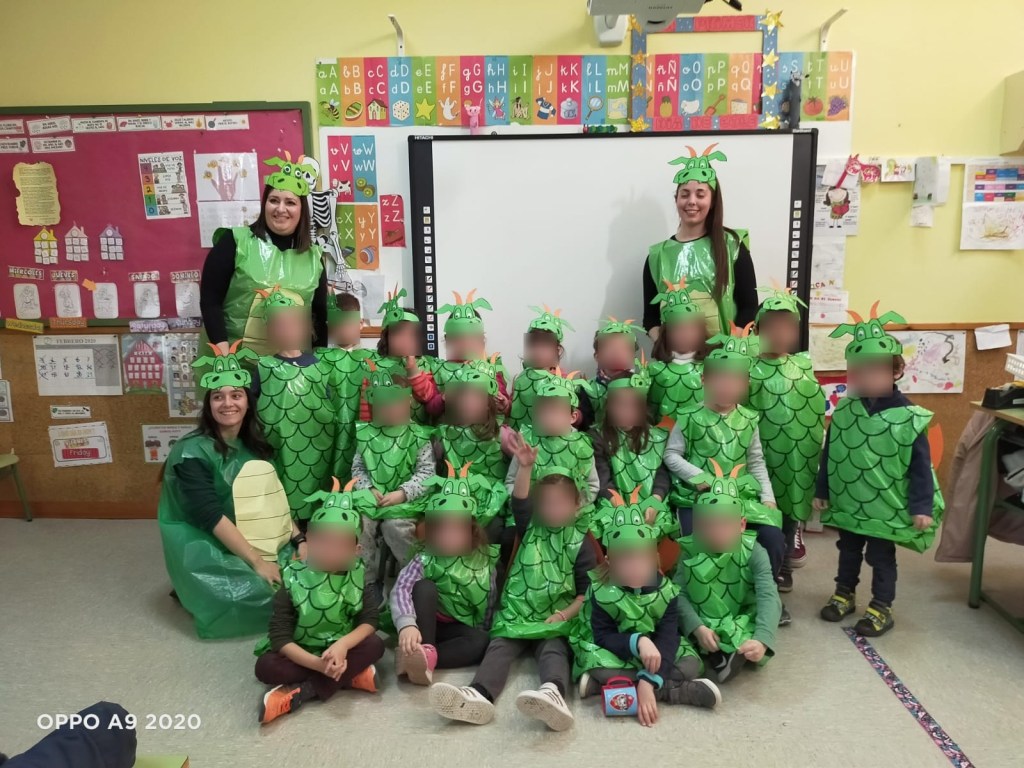
On carnival day dressed as dragons

TASK 2

A brief introduction to this task: this task consists of observing 2 videos of infant English classes and answer a series of questions related to the videos.

Answer each of the questions below in as much detail as you can:

Observer the classroom environment

  • How is the classroom arranged and how does this influence teaching and learning?

In both videos the classroom is organized in several corners, those that have been seen more in the videos are the assembly and the tables put in groups of 4 or 5 children and this influences in the teaching and the learning of positive form since to the being so organized the classroom, having a corner for each activity the children know where everything is and where the activities are made according to what is going to be done.

  • What kind of rapport (connection/interaction) exists between teacher and students and between students?

In both videos the type of relationship (connection/interaction) that exists between the teacher and the students is an almost mother-child relationship since the students see the teacher as a super important figure and one that they appreciate and love very much since they have been seen giving her kisses, hugs… . And the relationship between the students is also very good because for many children they are the first friends they have, and they treat each other very well.

Observe the teacher’s techniques

  • How does the teacher use verbal and non-verbal communication?

In both videos, the teacher uses verbal and non-verbal communication often and these complement each other almost all the time. For example, when they sing songs and explain activities, they always make gestures to help better understand what to do while

  • What types of questions does the teacher ask, and when?

In both videos the kind of questions the teacher asks are the following: what’s the weather like? what’s the day like? how do you feel? have you understood what needs to be done? what color is the ball? etc

  • What teaching strategies seem to be the most effective?

In both videos the teaching strategies that seem to be most effective are those in which children actively participate in the assembly. For example, when they sing songs and explain activities, they always make gestures to help better understand what to do while explaining something or singing.

  • How does the teacher use classroom media (boards, slides, video, music, etc.)?

The teacher uses classroom media in the following way:

In the first video, in the DAILY ROUTINE they all sing the good morning song together in the assembly, “the engineer” takes roll call by drawing sticks with the names of the classmates.

In PRONUNCIATION LAB AND HOME SCHOOLING, the children sitting in the assembly and the teacher in the middle with a chair take out flashcards and the children when they see the picture say the name of the object that appears on them. Then the teacher hangs the flashcards on a string and holds them with a clip and the driver has to hit the flashcard he hears in the audio with a palette

In LANGUAGE SKILLS, the teacher puts on a glove with drawn letters on each finger and all together sing the song twice in the assembly. Then they sing another interactive song related to the movement of the hands. To give them a new booklet the teacher makes it more fun by putting it inside a big red box in which the children have to press the green button so that the booklet falls out.

In PRE-MATH, in the booklet, the children have to join two elements that are related in this case an apple with the tree and a sheet of paper with the paint. When they finish, he puts a little face on them. In the standing assembly, the teacher takes out colored balls and the children have to say what color each ball is. When everyone has a ball, the teacher says up and down and the children have to do that with the ball and then the same thing individually. Then they do this activity in the booklet

In ACTIVITIES, a dog, a cat and a cow appear in the booklet and they have to put the corresponding sticker.

In the second video, the teacher puts a card on her T-shirt and when she puts it on all the children know that you can only speak in English. The class is divided into different sections and each one has a different color.

In the RED SECTION:

The teacher shows cards where different words and pictures appear, they sing the good morning song, they say what time it is, they say the numbers up to 10, the colors, the shapes (circle, square, rectangle, triangle and diamond). He also puts a song about the days of the week and projects it on the digital blackboard.

In the DARK GREEN SECTION, they do the PRONUNCIATION LAB, which that day has to do with body parts and colors: first they listen alone and then they are told to go over it at home.

In the YELLOW SECTION, with the booklet they make an exercise that has to do with the parts of the face, then the teacher projects in the digital blackboard the parts of the face and they are repeating it, later they touch between them the hair, the eyes, nose, mouth, ears.

In BLUE SECTION, the teacher projects the shapes on the digital blackboard, and they repeat them and put stickers on them when they get it right.

  • How does the teacher motivate students, and how do they respond?

The teacher motivates the students by doing many activities of short duration each, when they do it well she calls them excellent or very good and when they are doing an activity in the booklet she puts a stamp with a smiley face and with this she makes the children respond in a happy way and they feel like doing more activities to get more smiley faces.

Observe the students

  • What are the students doing to contribute towards the learning process?

What students are doing to contribute to the learning process is to learn many things either through songs, games or the booklet.

  • How active or passive are the students? Are they engaged?

Students are generally quite active as they get involved and committed to the various activities as it is all fun and learning for them.

  • Map the interaction patterns. Is it student to student, students to students, teacher to students, student to teacher, the same students again and again?

The interaction that takes place is of different types, there is student to student interaction, for example when the child takes out the sticks with the name of another partner to pass the list, students to students, when they are sitting in groups at the tables, teacher to student when the teacher asks a child what the weather is like today and student to teacher when the child needs or does not understand something and asks the teacher.

  • Does student behaviour change during the class? How and when?

In general, students’ behavior does not change much during class but there are always times when children are more talkative than others and there are always some children who behave a little worse than the rest.

  • Compare and contrast both videos. What is good about each class? What could be improved in both classes?

The good thing about each class is that the children in both classes are learning and having fun and that both teachers do different activities so that the children do not get tired of doing only one activity all the time.

And what can be improved in both classes from my point of view is that I would use the digital blackboard more to put songs and interactive stories for them to have a better time, but otherwise I think everything is pretty good, the only thing that the teacher of the second video could be a little more smiling and close to the students but in general both classes are good.
TASK 3

EVALUATED TASK 3 STORYTELLING

A brief introduction to this task: in this task we had to find a story that lasted at least 5 minutes to tell the infant or primary pupils according to the grade that we are studying, in my case infant pupils. To tell the story, I used drawings that I made and painted by myself. Finally record the video telling the story and create two activities related to the story which focus on language skills, in my case, to reinforce the vocabulary and comprehension of the story.

On the one hand, the strengths of this task are the following: the content of the story as I gave clear and interesting details to support the story, I also adapted the story completely for infant pupils and used drawings made and painted by myself. The chronological order of the story was clear and easy to follow, and I used signal words/transition

correctly. I used a lot of eye contact when recording the story and a great deal of volume, intonation and voice variety. The video lasted at least 5 minutes and I didn’t use notes to count it in front of the camera. Finally, the activities I created were well developed and reinforce the vocabulary and comprehension of the story.

On the other hand, the weaknesses of this task are these: there could have been more interaction from me with the audience and I could have asked more questions. There were some pronunciation errors, in addition I think it is very important to check the pronunciation of any word I say, as I will be a model for the students and they will copy/imitate the way I pronounce the words and mispronunciations can interfere with understanding the story. Finally, I could have smiled a little more.

In conclusion, if I could repeat the task’s contribution, I would improve all the weaknesses so that the task will be perfect.

A FINAL CONCLUSION

What I have learned during this course has been several things, for example, evaluated tasks and group projects always add to my learning as they are all different.

The evaluated task that has provided me with the most learning has been evaluated task 3 because what we had to do in this task, which was to tell a story for children in my case and create activities, is what I will really have to do when I am in the classroom as a teacher.

The group project that has provided me with the most learning has been group project 1, in which we had to create a 4-session project in relation to the children’s curriculum, my group and I did it on culture and society, since I will also have to do this type of project when I am in the classroom as a teacher.

The creation of this portfolio has also brought me learning because it has new tasks that you have to think about a lot since it includes personal reflections, observing videos and answering questions and recording an audio.

As for what we have given from the textbook, I have learned new vocabulary in almost all the units we have seen, and the use of the textbook has also helped me to review the grammar and to better consolidate all the concepts.

On the other hand, referring to the online classes due to the situation in which we find ourselves, I have also learned several things, such as that even if there are no face-to-face classes, it is possible to continue teaching, that the work that you teachers have done in organizing everything online is to be thanked and that I have adapted to this situation of online classes better than I thought.

I will continue to learn English on my own and it is clear to me that I will not give up English next year, even if there is no specific English subject in 3rd grade. I’m still not sure if I’ll sign up for an academy to continue studying or I’ll hire a private teacher, but I’ll do something. 

Finally, I want to continue studying English because besides the fact that it gives me the ability to speak one more language, as I want to dedicate myself to teaching I want to get the C1 degree in English and to be able to do that I have to continue studying English.